Summary
In total, Sam received 11 shocks from a defibrillator and a multitude of advanced life support interventions. Dr Langford, having intubated Sam, placed an arterial blood pressure monitoring line and carried out an ultrasound scan, discovering there was some electrical activity which still gave him a potential chance to pull through.
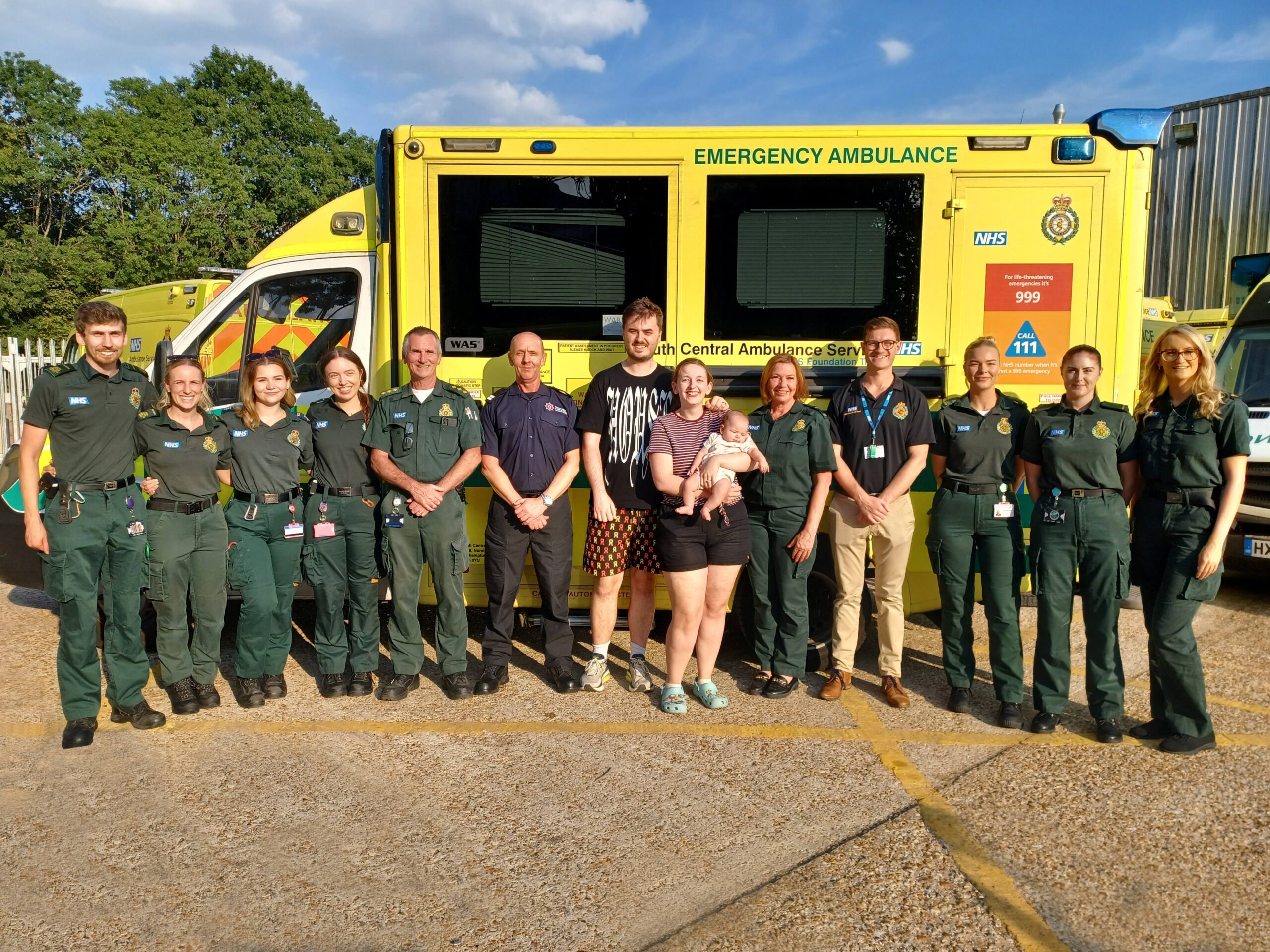
An 11-strong team with members from the ambulance service, fire and rescue service and an emergency on-call doctor met up with 26-year-old Sam King from Hedge End on Thursday, 16 July, so he could say thank you in person for saving his life three months previously.
It was in the early hours of Friday, 3 April, this year when, without any warning or previous symptoms, Sam suffered a cardiac arrest at his home in Hedge End, near Southampton in Hampshire.
His wife, Emma, who was 39-weeks pregnant at the time with the couple’s first child, immediately called 999 and was talked through giving CPR (or chest compressions) to Sam by South Central Ambulance Service (SCAS) emergency call taker, Sarah Smith.
“Emma was incredibly calm”, remembers Sarah, “and she did exactly what I was asking her to do. And it was only by her quick actions in immediately starting CPR that ultimately gave Sam the chance of surviving once all the additional help arrived.”
Back in the integrated clinical contact centre at Otterbourne, Hampshire, whilst Sarah remained on the phone with Emma supported by 999 team leader, Sarah Burnett, her colleagues, emergency dispatchers Georgia Mihill and Louise Winter, prioritised all available ambulance crews and other emergency responders in the vicinity of the emergency to race to the couple’s home
First to arrive was an ambulance crewed by paramedics Jack Kendall-Bohoslawec and Emily Forrell, along with Hampshire & Isle of Wight Fire & Rescue Service Firefighter, Malc Grendon, who had received additional medical training to be available as a co-responder for SCAS to serious medical incidents such as this.
They were soon followed by a second ambulance crew of paramedic, Sophie Kingston, and emergency care assistant, Kiana Sykes, and paramedic team leader, Mark Burnett, who arrived in a rapid response vehicle. Mark also called on-call volunteer emergency doctor from SCAS BASICS, Dr Edward Langford, to further assist given the critical condition Sam was in.
To complicate the situation further, Sam had collapsed on the top floor of the family’s three-storey town house, so all the personnel and equipment had to navigate two flights of stairs to commence their lifesaving treatment.
In total, Sam received 11 shocks from a defibrillator and a multitude of advanced life support interventions, but with his downtime getting towards the two-hour mark, the team would soon need to make a decision as to whether to continue treatment or not. As the time came to make the call, Dr Langford, having intubated Sam, placed an arterial blood pressure monitoring line and carried out an ultrasound scan of Sam’s heart, discovering there was some electrical activity and movement present which still gave him a potential chance to pull through.
Having placed a LUCAS device on Sam earlier in his treatment – a device that automatically carries out chest compressions – the team now had the tricky challenge of getting Sam, his stretcher and all the equipment he was attached to, down two flights of narrow stairs and into a waiting ambulance.
Dr Langford remembers the incident well, adding “A downtime of almost two hours usually means the outcome is unlikely to be survivable, or only survivable with the patient suffering life-changing effects, so I think we all hoped for the best, but were fearing the worst.”
Sam was blue-lighted to University Hospital Southampton (UHS) in the ambulance of Jack and Emily, with Dr Langford and Malc travelling in the back.
Having been stabilised at UHS, Sam was still in a critical condition with multiple organ failure and was transferred to St Thomas Hospital in London where he spent 12 days in the intensive care unit and then a further five days in the ICU back at UHS.
“We didn’t know, and no one could really tell us”, adds Emma, “what sort of condition Sam might be in if he were to come out of his induced coma and survive. We just had to wait and hope.”
Emma went into labour four days after Sam’s cardiac arrest and gave birth to a healthy baby girl, Sophie. Soon after her birth, Sam was awake but not really responding and the first indication that things might be looking positive was the first time he set eyes on his new baby daughter.
“He was trying to hold her and there were tears coming from his eyes”, remembers Emma.
After a total of 33 days in hospital, Sam was discharged to continue his recovery and rehabilitation at home on 6 May.
Incredibly, Sam has made a complete recovery and although he now has an ICD fitted – an implantable cardioverter defibrillator that can detect and correct dangerous heart rhythms by giving an electric shock – he has suffered no other neurological or physical disability.
Shortly before meeting the team that helped save his life, he had even gone back to work.
“Obviously I don’t remember anything that happened that day”, says Sam, “but it was important for Emma and I to reach out and meet everyone involved face-to-face because without all of them doing what they did that night, I wouldn’t be here today.”
“Amazingly, I feel completely normal – and apart from a few scars in various places – there’s nothing really to show what I’ve been through. No cause has been identified for my cardiac arrest in all the tests and scans I’ve had and I feel like I’m back to living as normal a life as a I did before.”
“Emma and I are big music fans and we’ve even recently gone out to a gig – though regrettably my mosh pit days are behind me! To be able to meet the team and say thank you in person has been really special. I’ve absolutely no idea how I’m still alive but very grateful that I am. I’ll never forget the second chance they’ve given me.
Ends
Main Photo L-to-R:
Jack Kendall-Bohoslawec, Sophie Kingston, Kiana Sykes, Emily Forrell, Mark Burnett, Malc Grendon, Sam King, Emma King with Baby Sophie, Sarah Smith, Dr Ed Langford, Georgia Mihill, Louise Winter, Sarah Burnett