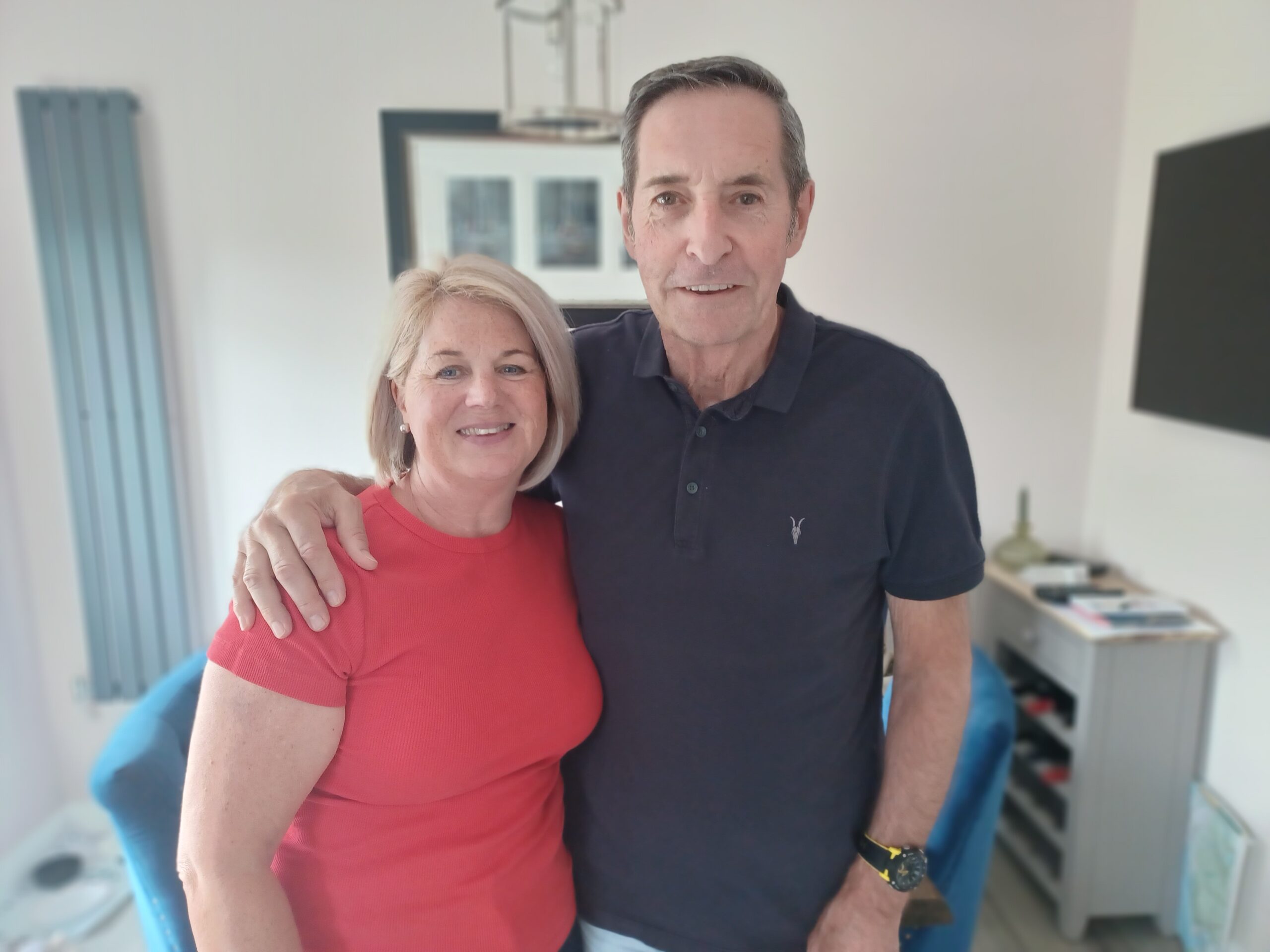
A resident of Newton Blossomville in Buckinghamshire who survived a severe stroke in May 2025 is urging everyone across the South Central region to know their numbers by having a blood pressure monitor at home.;
Gary Tomlin, 70, was looking forward to enjoying a family barbecue on the evening of Friday, 2 May 2025, when he began to feel unwell. His wife, Samantha, who herself had suffered an ischemic stroke a year earlier, thought Gary might also be having a stroke.
Samantha said: “Gary had popped out to get some last-minute provisions and when he came back I immediately knew something wasn’t quite right. He wasn’t slurring, but his speech was very different. I got him to touch his nose, raise his hands – which he could do – but then I took his blood pressure and it was sky high.”
Having called NHS 111 and detailed Gary’s symptoms, the call was transferred to the South Central Ambulance Service 999 control room and local community first responder, Sarah Curd, who was on call in the area was sent to the couple’s home.
Sarah said: “When I arrived I was taken into the garden where Gary was seated and realised quite quickly he was very unwell. Whilst he didn’t have a noticeable facial droop and he wasn’t slurring, Gary did have weakness in his arms, he was unable to stand up from the seat he was in and his blood pressure was extremely high. After carrying out some initial tests and assessments, I contacted the control room to inform them that Gary was FAST positive and to confirm an ambulance crew was needed ASAP.”
FAST positive indicates that a person shows one or more signs of a stroke:
F – Face drooping. One side of the face may droop or feel numb.
A – Arm weakness. One arm may be weak or numb.
S – Speech difficulty. Speech may be slurred or the person may have trouble speaking or understanding language
T – Time. Immediate medical attention is required if any of the above signs are present
The ambulance crew arrived 30 minutes after Sarah and, having given the lead paramedic a full handover, the crew were able to quickly load Gary on to the ambulance and take him and Samantha to the specialist stroke unit at the Luton & Dunstable Hospital. Having been pre-alerted by the ambulance crew en route, a hospital team was waiting for Gary on arrival and the couple were immediately assigned a stroke nurse.
Gary added: “I still remember the evening quite clearly, coming home, Sam making me touch my nose, raise my arms and then – because I do what I’m told – telling me to sit in the chair outside. But I couldn’t get myself out of the chair and having taken my blood pressure, I remember Sam calling 111.”
At hospital it was discovered Gary had suffered a serious bleed on the brain and was initially very disabled by it. He spent two weeks at Luton & Dunstable in the critical care section of the stroke ward, before being transferred to a specialist rehabilitation centre in mid-May. He was determined to walk out of the centre and was able to do so in September last year to continue his recovery at home.
Undertaking regular hydrotherapy sessions twice a week, Gary has also recently joined a local gym to follow a dedicated programme of activity and now feels he is around 80-85% recovered physically.
With his own experience of stroke, Gary is now urging everyone to regularly check their blood pressure.
“I think it would be great if every household had a blood pressure monitor”, he says. “It helped us that day having it to hand so Sam could take my blood pressure reading. We then realised the severity of what might be happening because my initial symptoms seemed mild.”
As well as increasing your risk of a stroke, high blood pressure also increases your risk of heart attack, kidney disease, vascular dementia and early death. Checking your blood pressure is quick, simple and can be genuinely lifesaving. If you’re over 40, it is recommended that you aim to check your blood pressure at least once a year, either by using a home monitor or by visiting your GP or local pharmacy.
The British & Irish Hypertension Society has a list of approved blood pressure monitors here: Find a Blood Pressure Monitor You Can Trust | British & Irish Hypertension Society
Almost a year after Gary’s stroke, Sarah – who has since stopped working as a volunteer community first responder for SCAS – returned to the couple’s home in Newton Blossomville to see how Gary was recovering.
You can watch a short video of their reunion below:
Volunteer community first responders (CFRs) are trained to respond to life-threatening emergencies and provide essential life-saving treatment and support in the crucial minutes before an ambulance crew arrives. The SCAS Charity funds the uniform, equipment and training of all volunteer CFRs with monies raised by donations, fundraising efforts and grants.
Find out more about the work of the SCAS Charity here: scas.charity.org.uk
Ends